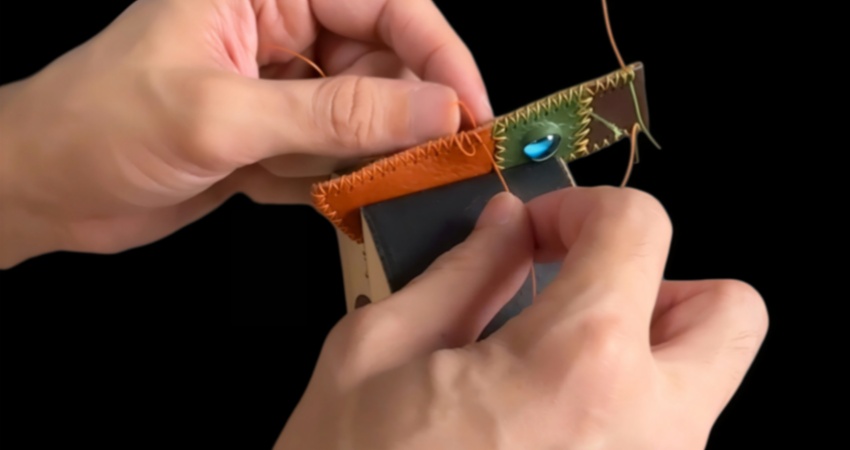
The easiest way to understand a hand-stitched leather watch strap is to look at its joins. Where do the leather panels meet? How does the thread follow the edge? Which details are raised, and which sit against the leather?
On an ANIMOVIBE strap, these parts remain visible. They explain how the piece is put together—and why one design looks different from another.
Start with the Leather Texture
We use vegetable-tanned cowhide on both the outside and the inner, skin-facing layer of our straps. Different designs use different selections of leather, so colour and texture vary across the collection.
In the orange, green and brown design, the changes between panels are easy to follow. The black sections on other designs create a different contrast with brighter colours and metal accents.
Look at close-up photographs as well as the full product image. A distant view shows the colour arrangement; a closer view reveals the grain and surface texture.
Natural grain varies, so the finished strap may not repeat every mark in a photograph. That variation is different from damage or a poorly secured component.
Follow the Waxed Thread
Our straps are stitched by hand using waxed thread. The thread outlines the leather and makes the connections between panels part of the design.
Its colour changes how those joins appear. A contrasting thread draws attention to the construction, while a closer colour match makes the line less prominent.
Hand stitching can show small variations in placement. It should not be used as an explanation for loose thread or a separating join. Those are details to have checked.
Look at Glass and Metal Together
The glass eye is often the first detail people notice, but it does not work alone.
A star, triangle or hexagon changes the appearance of the surrounding leather. Snaps and connectors add another finish, while the stitching frames the whole arrangement.
ANIMOVIBE connectors are stainless steel. Depending on the model, snaps and decorative shapes use stainless steel or bronze. The eye is decorative glass secured with adhesive, not a natural cat’s-eye gemstone.
For the exact hardware used on a particular design, check its product description rather than assuming every model uses the same combination.
Check the Inner Side, Too
The front attracts attention, but the inside is worth looking at before you choose.
An inner-side photograph helps you understand the leather surface, the edges and how the fastening is arranged. It also gives a more complete view than a photograph showing only the watch face and eye detail.
Choose the Combination You Will Enjoy Wearing
A strap can look striking in a close-up and feel quite different as part of an outfit. Compare a full-length product photograph with a wrist photograph where available.
Notice the overall colour balance, not just one decoration. The piece you choose should work as a whole: leather, thread, glass and metal.
Explore the ANIMOVIBE collection to compare the designs, or read Materials & Craft for the component details.